

Cart
0
You may also like


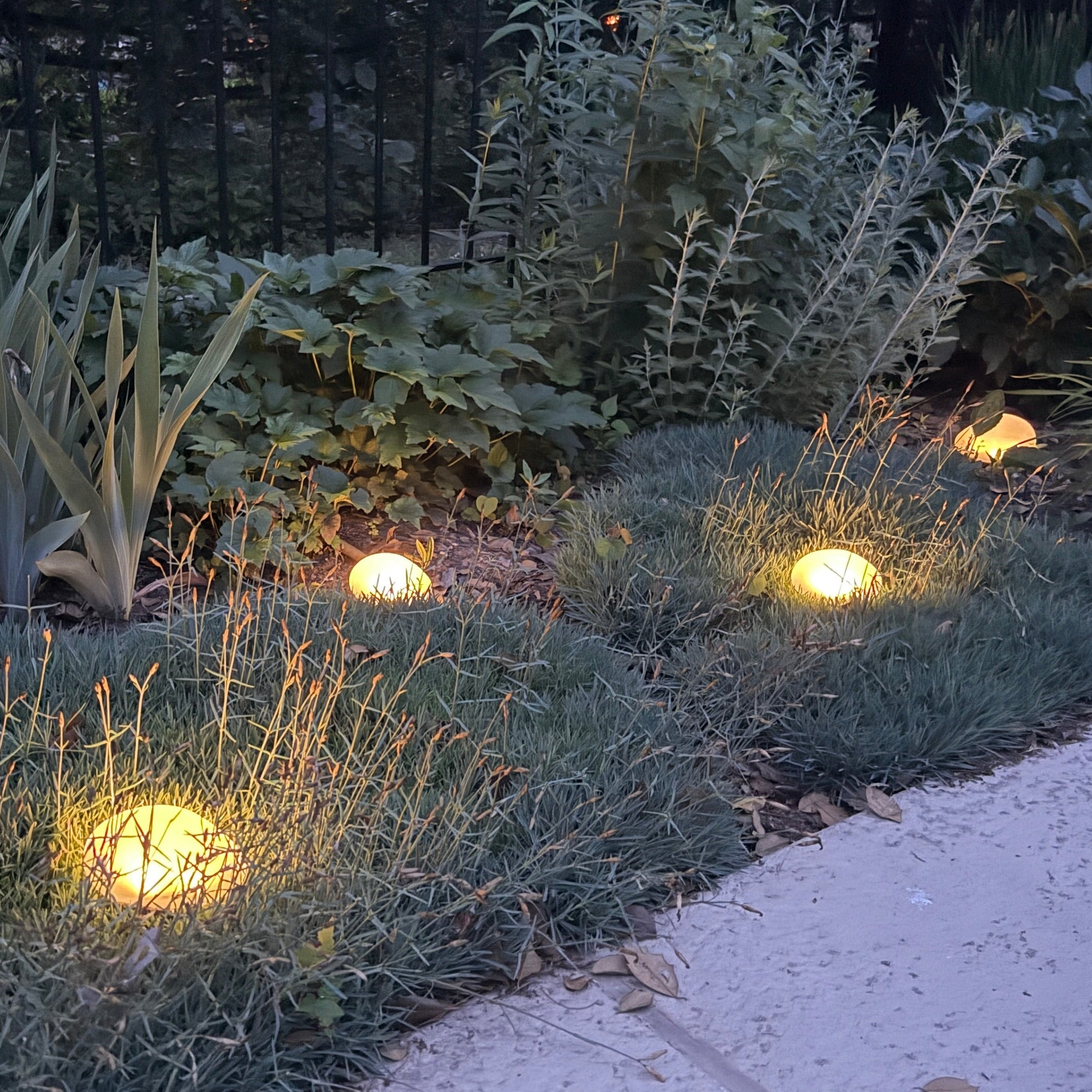
Every yard has a few dark corners: the edge of a garden bed, the last stretch of a path, the border along the patio that disappears once the sun goes down. The usual fix is a row of plastic stake lights, which look cheap by day and tip over by the season's end. Solar stone lights solve the same problem in a nicer way. They are frosted-glass stones that charge by day, blend into the planting, and glow warm white at dusk, all with no wiring at all. Here is how they work and where to use them.

These have quickly become one of my favorite things we make, because they answer a real frustration with a simpler idea. No cords to bury, no batteries to buy, nothing to switch on each night. You set them out, and the sun and a hidden sensor handle the rest.
Solar stone lights are outdoor landscape lights molded from frosted glass to look like natural river stones. A small solar panel hidden beneath the glass charges from daylight, and the stone gives off a soft, warm-white glow after dark. Because they look like real stones, they blend into garden beds and borders by day and light the same spots at night, with no wiring, no cords, and no stakes to push into the ground.
The idea is simple: a light that does not look like a light. By day, a solar stone reads as part of the landscaping, a smooth frosted stone tucked among the plants. At dusk, it turns into a warm point of light exactly where you placed it. Ours are made from heavy, textured frosted glass rather than thin plastic, so they have real weight and a natural look, and they are fully weatherproof and UV-resistant so sun and rain do not cloud or crack them.

A high-efficiency solar panel sits hidden beneath the frosted-glass surface and charges an internal battery from daylight. A built-in dusk-to-dawn sensor then lights the stone automatically at dusk and switches it off at dawn, so there is nothing to turn on or off yourself. A concealed switch adds dual-mode control: in the ON position the stone charges and lights at night, and in the OFF position it still charges by day but stays dark, so you keep the battery topped up on nights you want no glow.
Everything happens on its own once the stone is out in the sun. The panel under the glass gathers daylight and stores it, the sensor reads the fading light at dusk and switches the glow on, and at sunrise it shuts off to start charging again. The dual-mode switch is the clever part: because the stone charges in both the ON and OFF settings, you can leave a stone off for a quiet evening without losing its charge, then flip it back on whenever you like. When you first set them out, turn the switch to ON and give them at least eight hours of direct, unshaded sun to prime the battery.
| Material | Frosted glass, weatherproof and UV-resistant |
| Sizes | Medium and large |
| Light | Soft warm white, dusk to dawn |
| Power | Solar, no wiring or batteries to buy |
| Best for | Paths, beds, borders, patios |
Place solar stone lights anywhere you want a soft glow with no wiring: along a path or walkway, tucked into garden beds and borders, nestled in mulch, beside potted plants, on stone steps, or around the edge of a patio. The one rule that matters is sunlight. Set each stone where its top surface sees open sky for most of the day, since that is where the panel charges. Deep shade under dense trees or eaves shortens the nightly glow, while even partial daily sun keeps them cycling reliably.
Because there are no cords or stakes, placement is as easy as setting a stone down. Line them along a walkway to mark the edges, scatter a few through a flower bed, rest one on each stone step, or ring a patio to give it a warm evening border. The low-profile, flat-bottom shape means they sit securely wherever you put them and will not lean or topple. Just keep the top surface clear of low-hanging leaves, tall grass, and furniture shadows, since anything covering the glass blocks the charge and dims the glow. For a patio you are already dressing with potted florals or a cafe lamp, a few stones along the border tie the whole space together after dark.

For most people, yes. Plastic stake lights are cheaper up front, but they are lightweight, tend to crack in frost, fade in the sun, and get knocked over or clipped by a mower. Solar stone lights are made of heavy frosted glass with a low-profile, flat-bottom design, so they sit securely, look natural in the landscape, and hold up to weather without the brittleness of plastic. If you want lighting that lasts and looks intentional rather than temporary, the glass stones are the better long-term choice.
Plastic stakes have their place: they cost little and work for a quick, short-term fix. The trouble is that they rarely last. Thin plastic goes brittle in the cold, the panels on top cloud over and fade, and a stake sitting up out of the ground is easy to catch with a mower or a stray foot. A solar stone sits low and flat, with its panel protected under weatherproof, UV-resistant glass, so there is nothing to snap off and nothing perched up waiting to be knocked. It also looks like it belongs, reading as a stone in the bed rather than a row of plastic spikes. You buy it once and it stays put.

Yes. The frosted glass is heavy-duty, fully weatherproof, and UV-resistant, so it stands up to sun, rain, and everyday outdoor use without clouding or cracking. Care is minimal: keep the top surface clear of leaves and grass so the panel can charge, and wipe off dust or pollen now and then for the brightest glow. In regions with severe winters, switch the stones to OFF and store them indoors through the hardest months to protect the glass and extend the life of the internal battery.
These are built to live outdoors, and the glass is the reason they last where plastic fails. Day to day, they ask almost nothing of you: a quick wipe when the surface gets dusty and a glance to make sure nothing has grown up over the top. The only seasonal step is winter. If you get hard freezes, flip each stone off and bring them inside until spring, which spares both the glass and the battery the worst of the cold and keeps them cycling for years. Treated that simply, a set of stones becomes a permanent part of the garden you never really have to think about.
Real frosted glass, a hidden solar panel, and a dusk-to-dawn glow with no wiring. Two sizes, ready to set out and forget.
Shop Solar Stone Lights Outdoor lightingYou might also be wondering: how many do you need? For a path, space one stone every few feet so the glow is continuous rather than spotty. For a bed or border, a small cluster of two or three reads better than a single stone lost among the plants. Mixing the medium and large sizes keeps the grouping looking natural.
Tap a question to see the answer.
Solar stone lights are the rare outdoor upgrade with no catch: no wiring to run, no batteries to buy, nothing to switch on each night. You set the frosted-glass stones where you want a soft glow, give them a day in the sun, and they light your paths, beds, and patio edges on their own from dusk to dawn. They look like landscaping by day and hold up outdoors for years, which is exactly what plastic stakes never manage. Set them out once and enjoy the glow.
Shop Solar Stone Lights Outdoor lightingCharging performance depends on daily direct sunlight and placement. Follow the included instructions for first-use charging, and switch stones off and store them indoors during severe winter conditions to protect the glass and battery.


Ready for a holiday season with all glow and no upkeep? The full Christmas range is ready to shop.
SHOP CHRISTMAS DECOR
