

Cart
0
You may also like


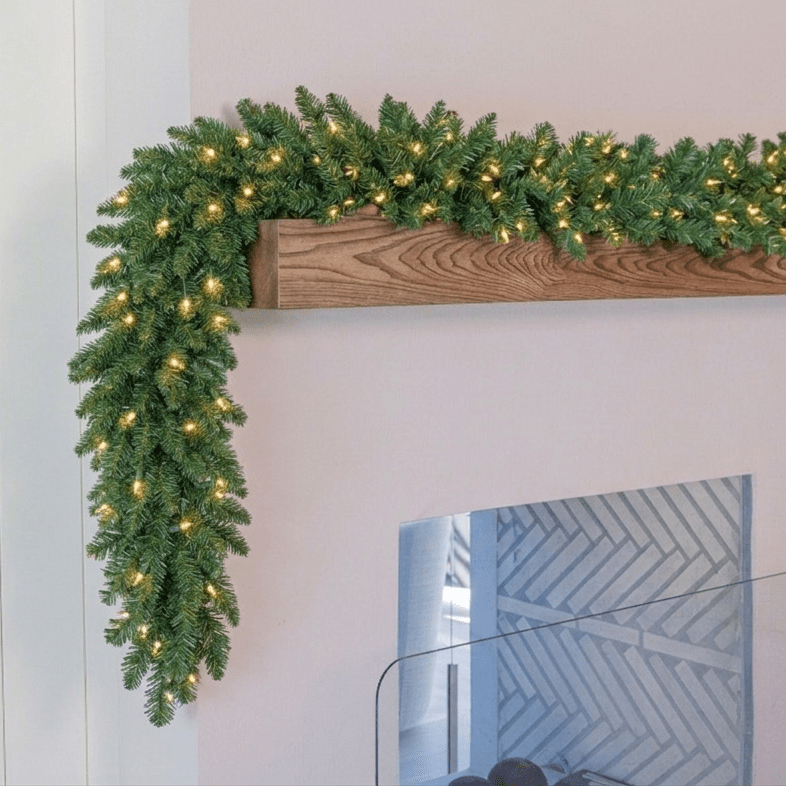
Most people buy one garland, hold it up to the staircase, and realize they needed four. Garland is measured in linear feet, and it adds up faster than anyone expects once you start draping it. The good news is that you can plan the whole house in a few minutes with one simple rule, so you order the right number of nine-foot garlands once instead of making three trips. A full exterior plus the key interior spots often comes to somewhere between ten and fifteen nine-foot lengths, which is usually more than a first guess.

We have made pre-lit garland since the early 1990s, so we have watched a lot of people under-buy. This guide fixes that. It gives you one measuring method that works for every spot in the house, a room-by-room count for a typical home, and the one power detail that decides how you group your order. If you are also working out when to put it all up, our timeline on how early to decorate for Christmas pairs with this one.
A typical house needs about 10 to 15 nine-foot garlands for a full look: the front door, porch railing, a staircase, the mantel, and a few windows or columns. The exact number depends on how much you drape and how many features you decorate, but almost everyone needs more than they first guess, because a draped, swagged look uses roughly half again as much garland as the straight-line measurement suggests.
There is no single answer, because no two houses have the same railings, windows, and columns. But the pattern is consistent: people measure the straight run, buy that much, and come up short once they start letting the garland dip and swag the way it is meant to. So the honest headline number for a fully decorated home, inside and out, is usually in the ten-to-fifteen range. The way to get your own number is to measure each spot and apply one simple rule.
Measure the straight run of each spot, multiply by about 1.5 for a soft draped look, then divide by 9 to get the number of garlands. Decorating pros recommend 1.5 to 2 feet of garland for every linear foot of railing or mantel so the garland drapes instead of pulling taut. Since each Celestial garland is 9 feet, dividing your total footage by 9 and rounding up gives you the number to buy.
This is the whole method, and it works for every spot in the house. Measure the length of the railing, mantel, or door frame, then add half again for the drape, because garland should dip softly between its anchor points rather than run tight like a rope[1]. Divide that total by nine and round up. That is your count.
Measure the straight run of each spot: the railing length, the mantel width, the outline of the door frame.
Multiply by about 1.5 for a soft, draped look. Use closer to 2 for full swags, closer to 1.25 for a tight, tailored line.
Divide the total by 9 and round up. That is how many nine-foot garlands the spot needs.
A staircase usually needs about 3 nine-foot garlands. The easiest way to size it is to count your steps and multiply by two, which gives the footage for a railing draped one to two feet below the handrail. A typical thirteen-step staircase comes to about 26 feet, or three garlands connected into one run. For a tighter, tailored look, use the lower end and you may need only two.
The staircase is the spot people most often under-buy, because the swag between the balusters hides how much length it takes. The count-your-steps-times-two rule is the shortcut the professionals use, and it lands in the same place as the measure-and-a-half method[1]. On most homes that means three garlands, which connect neatly into a single 27-foot run on one plug or battery. Secure it at the newel post and every few balusters so the swags stay even.

A standard mantel takes 1 nine-foot garland, which gives enough to drape across and hang over both ends. A full front-door surround takes 2 to 3 garlands, or roughly 24 feet, tied at the center and running down each side. If your mantel is short and you want a tailored line, one garland is plenty; if you want deep side drapes or a double-door frame, plan for the higher end.
For the mantel, measure the width and multiply by 1.5 to 2, which for most mantels lands between 6 and 10 feet, so a single nine-foot garland covers it with a little to hang over the sides[1]. For the front door, decorating teams often use about 24 feet cut into sections, tied over the center so each side drapes toward the ground. That is two to three garlands, which happens to be the exact length that connects on one power source. Our front door guide shows how to balance that garland with the wreath.
For a porch railing or a column, measure the length and multiply by 1.5, then divide by 9. A typical porch railing of 12 to 16 feet needs 2 to 3 garlands; each column or post usually takes 1 garland wrapped from top to bottom. Because Celestial garlands connect up to three on one plug or battery, group each run so no single powered stretch exceeds 27 feet, and start a new power source beyond that.
Exterior runs are where the total climbs, so this is where planning power matters. Measure each railing and column, apply the same measure-and-a-half rule, and divide by nine. Then group the garlands by power: up to three connect into one 27-foot run on a single plug or battery pack, and anything longer needs a second source. Because the lights are LED, a full connected run can stay lit on a timer all season for very little[2]. Deciding between plug-in and battery for those runs is its own question, and our guide on plug-in versus battery garland walks through it.
| Front door surround | 2 to 3 garlands |
| Porch railing (12 to 16 ft) | 2 to 3 garlands |
| Staircase (count steps x 2) | about 3 garlands |
| Mantel | 1 garland |
| Columns or posts (each) | 1 garland |
| Windows and extras | 1 to 2 garlands |
Every Celestial garland is 9 feet, connects up to three on one power source, and comes UV-treated for indoors or out. Plan your count, then order once.
Shop garlandsYou might also be wondering: is it better to buy a little extra? Yes. Leftover garland is easy to use on a mirror, a shelf, or a second window, and it is always easier than coming up short mid-project. When in doubt, round up to the next full garland.
Tap a question to see the answer.
Garland always takes more than the first guess, but the math is simple: measure each spot, add half again for the drape, divide by nine, and round up. Count the front door, the porch, the staircase, the mantel, and the windows, and most homes land between ten and fifteen garlands. Group them into runs of three for power, buy a little extra, and you will decorate the whole house in one trip instead of three. Add a wreath on each door and the entrance is complete.
Shop garlands Plug-in vs batteryCounts are typical ranges for planning and vary with your home's dimensions and how much you drape. Measure each spot before ordering, and round up when a number falls between two garlands.


Ready for a holiday season with all glow and no upkeep? The full Christmas range is ready to shop.
SHOP CHRISTMAS DECOR
