

Cart
0
You may also like


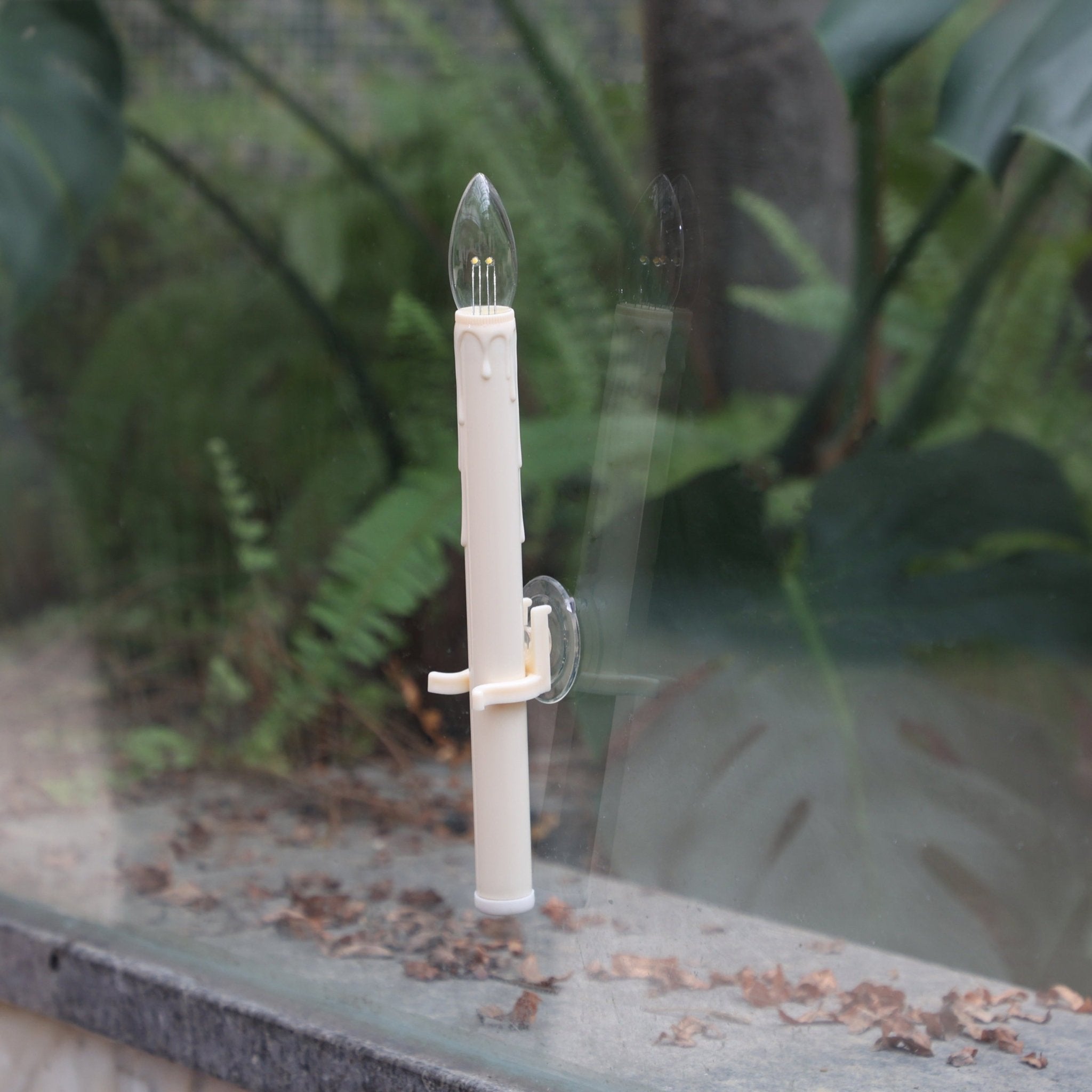
People ask how bright a window candle should be, and the honest answer surprises them: not very. A window candle is a soft glow meant to read from the street, not a light that fills the room. Too dim and it disappears against the glass; too bright and it glares back at you from inside and looks more like a floodlight than a flame. The sweet spot is a modest, warm glow, and the color of that glow matters even more than its strength. Here is how to get both right.

We have made window lighting since the early 1990s, and brightness is where people most often get a window candle wrong, usually by reaching for the brightest, whitest option they can find. This guide covers the two things that actually decide how a window candle looks: how much light it gives, and what color that light is.
A window candle should be just bright enough to be clearly visible from the street at night, which is a modest amount of light, not a lot. It is accent lighting meant to signal a warm, lit home, not task lighting meant to illuminate a room. Brightness is measured in lumens, and a window candle needs only a low output; going brighter makes it glare from inside and look artificial. The soft glow of a real candle flame is the target.
The instinct is to buy the brightest candle available, and it is the wrong instinct. A window candle is meant to look like a single flame in the glass, and a flame is not bright. What you want is enough light to read clearly from the sidewalk or the street after dark, and no more. Push past that and the candle stops looking like a candle: it glares back at you from inside the house and reads as a plastic light rather than a soft flame. Brightness, measured in lumens, is separate from color[1], and for a window candle the right amount of it is modest.
Enough to read from the street, not a floodlight. A window candle is a glow, not a room light.
Around 2700K, the amber tone of a real candle flame. Not cool, blue-white daylight.
Bright toward the street, soft toward the room, so it reads outside without glaring inside.
Warm white is far better for a window candle. Warm white, around 2700K on the Kelvin scale, is the soft amber glow of a real candle flame or a traditional incandescent bulb, and it reads as cozy and inviting from the street. Cool white, at 5000K or higher, is a crisp blue-white daylight tone that looks harsh and clinical in a window and breaks the illusion of a flame entirely. For a window candle, always choose warm white.
This is the choice that matters most, and it is the one people get wrong when they shop by brightness alone. Color temperature is measured in Kelvin: lower numbers are warm and amber, higher numbers are cool and blue[1]. A real candle sits around 1800 to 2000K, and warm white LED at roughly 2700K is the closest everyday match, which is exactly why it looks like a flame in the glass[2]. Cool white at 5000K and up looks like a phone flashlight in the window: bright, blue, and clearly artificial. Our window candles use a warm-white bulb for this reason, so the glow reads as a flame rather than a gadget.
A single-direction bulb forces a compromise: bright enough to see from the street usually means bright enough to glare from inside, and soft enough for indoors means too faint outside. A bi-directional bulb solves this by sending brighter light toward the street and softer light back into the room. That way the candle reads clearly from outside, where you want it seen, without becoming a distracting glare on the windowsill from your chair inside.
This is the tension nobody warns you about. A window faces two directions, and a plain bulb treats both the same, so you are stuck choosing between a candle that shows outside and one that is comfortable inside. A bi-directional bulb is designed to do both at once, throwing its brighter light outward for street visibility and a gentler light inward so it never glares at you from across the room. It is the detail that lets a window candle be truly bright where it counts and still soft where you live. Our adjustable window-hugger candles use a bi-directional bulb for exactly this reason.

Yes. Every window candle across the front of the house should be the same brightness and the same warm-white color so the facade reads as one even glow. Mixing brightnesses or mixing warm and cool white makes the windows look mismatched and draws the eye to the odd one out. Buying a matched set, ideally from the same product line, is the simplest way to keep every window identical.
Uniformity is what separates an intentional display from a scattered one. If one window is brighter or bluer than the rest, that is the window everyone notices, for the wrong reason. Keep every candle the same warm white and the same output, set to the same height, and the whole front of the house reads as a single, calm line of light. The easy way to guarantee it is to buy a matched set rather than assembling candles from different sources, since even two warm-white bulbs from different makers can differ enough to show. For more on placing them evenly, see our guide to the Christmas entryway.

Warm white, softly bright, and aimed at the street. Our window candles are built to glow like a flame, not a floodlight.
Shop window candles Window Hugger candlesYes. LED window candles use very little energy and stay cool to the touch, so leaving a soft glow in the window all evening costs almost nothing and carries no fire risk. Because they are flameless LED, there is no open flame near curtains, and a built-in timer turns them on at dusk and off overnight on their own. A soft, warm glow left on all evening is exactly what a window candle is meant to do.
Part of why a window candle can stay modestly lit all evening is that LED costs so little to run. LEDs use about 70 percent less energy than old incandescent bulbs and run cool rather than hot[2], so a low, warm glow in every window is inexpensive to leave on from dusk to bedtime, and there is no heat or flame near the curtains. Set the timer once and each candle handles the rest, which is the whole point: a soft, steady light in the window every evening with nothing to think about. For a fuller comparison of models, see our guide to the best battery operated window candles.
You might also be wondering: what about a flickering or twinkle setting? A gentle, slow flicker can make an LED read even more like a real flame, which is why some candles offer it. A fast twinkle, on the other hand, looks like a string light rather than a candle, so if you want the flame look, keep any flicker soft and slow.
Tap a question to see the answer.
The best window candle is not the brightest one. It is a soft, warm-white glow, about the color of a real flame, bright enough to read from the street and gentle enough that it never glares back at you inside. Choose warm white over cool, keep the output modest, match every window, and let a bi-directional bulb send the light where it belongs. Get those right and a single candle in the glass does what it has always done: signal a warm, welcoming home.
Shop window candles Adjustable window candlesColor temperature and brightness guidance are general lighting principles; exact output varies by product. Choose warm white for the traditional candle look, and match all candles on one facade for the most cohesive result.


Want that warm window glow with no cords and no wobble? Our patented Window Hugger® candles are ready to shop.
SHOP WINDOW CANDLES
