

Cart
0
You may also like


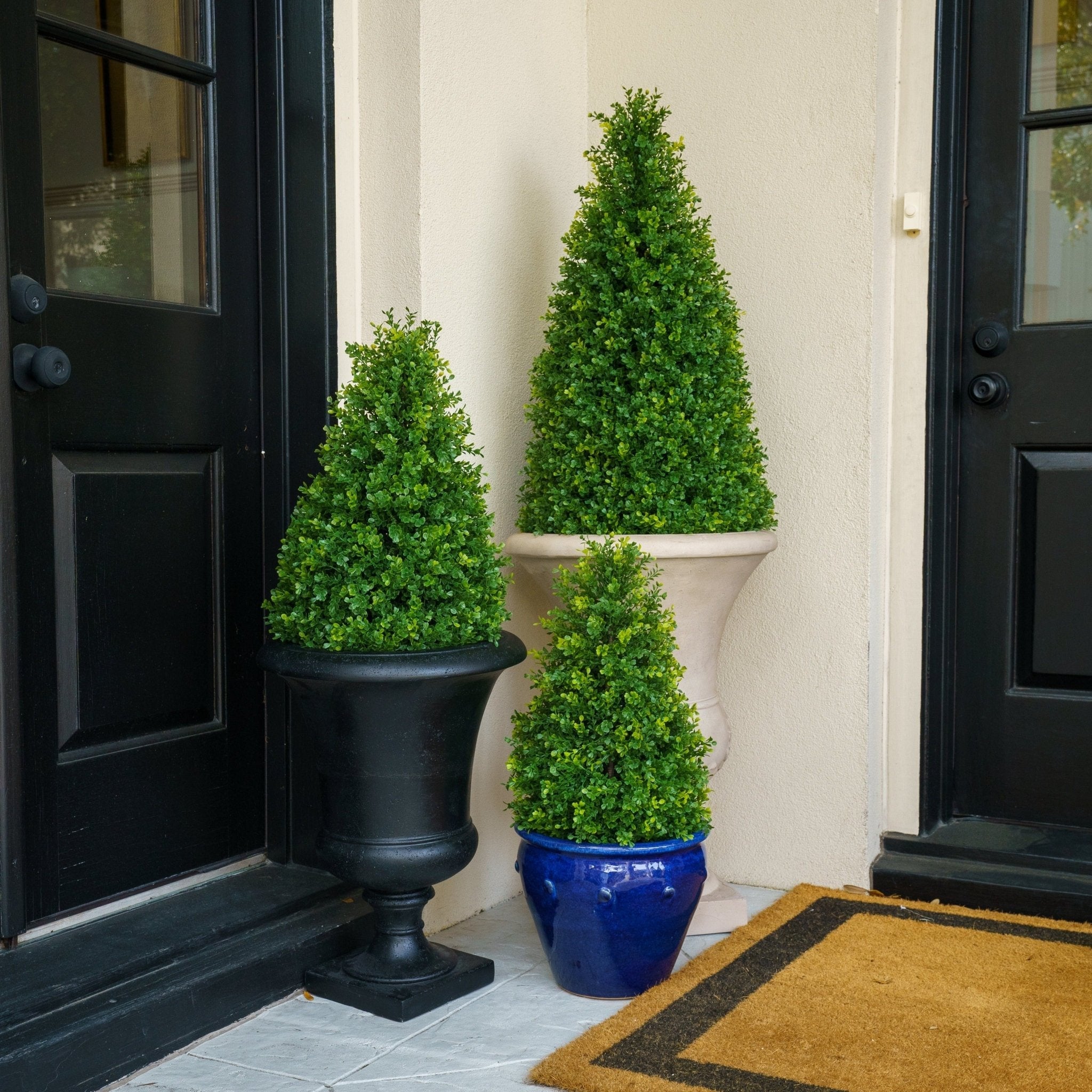
Nothing frames a front door quite like a pair of matched topiaries standing guard on either side. It is the trick behind almost every entry that looks polished from the street: structured green, repeated symmetrically, giving the doorway a sense of order and welcome. The catch with live boxwood is that it needs constant clipping to keep that shape, and it browns in winter right when you want it to look its best. Artificial boxwood topiaries give you the same clipped, evergreen structure with none of that, so the look is there year-round, curb appeal in December as easily as in June. Here is how to choose the right shape and size, and how to style them for a front door that always looks its best.

A front door topiary does a lot of work for how simple it is: it is just a sculpted evergreen form in a planter, but placed in a pair it transforms an entry. The only real decisions are shape, size, and how many, and this guide walks through each.
A front door boxwood topiary is a shaped piece of dense evergreen boxwood foliage, most often a sphere, a cone, or two stacked spheres, mounted on a stem or stake to sit in a planter or urn beside an entry. Ours are artificial, crafted from lifelike UV-treated foliage on a wire frame, so they deliver the clipped, manicured look of a real boxwood topiary without any watering, pruning, or seasonal browning. Placed in a matched pair on either side of the door, they give an entrance instant structure and symmetry, all year round.
The topiary is one of the oldest tricks in garden design because it works: a clean geometric form in green reads as intentional and cared-for from a distance. Traditionally that meant clipping a live shrub into shape and keeping it there with regular trimming. An artificial boxwood topiary skips the maintenance entirely. Each of ours is built from dense, textured foliage on a frame with a stake at the base, so it drops into a planter or urn and holds its exact shape indefinitely. Because the foliage is UV-treated and fully weatherproof, the same topiary that anchors your porch in spring is still crisp and green through the coldest, grayest part of winter, which is precisely when a live boxwood would be at its worst.
Choose by the feeling you want. Spheres give soft, rounded symmetry and sit beautifully in urns and planters, starting at $76. Cones bring height and structured, formal drama, standing up to 36 inches to flank a door, from $129. The double topiary, two stacked spheres on a stem, makes the tallest statement at 48 inches for a grand entry. Many homes mix them, cones for height at the door and spheres clustered lower, but a matched pair of any one shape is the simplest way to a polished look.
Each shape sets a slightly different tone. The boxwood sphere is the soft, approachable choice: a clean ball of green that looks classic in a stone urn or a simple planter, and its rounded form flatters traditional and modern homes alike. The boxwood cone is the formal one, its tapered height draws the eye up and gives a doorway a stately, symmetrical frame, which is why cones are the go-to for flanking an entry. The double topiary sphere stacks two balls on a single stem for real presence, standing tall enough to make a statement on a larger porch. There is no wrong answer; it comes down to whether you want your entry to feel soft and welcoming or tall and formal.
| Sphere | From $76 | 15 to 25 inches; soft, rounded symmetry in urns and planters |
| Cone | From $129 | Up to 36 inches; structured height to flank a door formally |
| Double sphere | $200 | 48 inches; two stacked spheres for a tall statement (check availability) |

Scale the topiary to the door and the planter. For spheres in urns or planters, 16 to 24 inches gives an abundant, well-proportioned presence beside most entries. For height that frames a standard door, choose a cone up to 36 inches, which reads clearly from the street without overwhelming the doorway. As a rule, the topiary and its planter together should reach roughly a third to halfway up the door. Buy two of the same size for a matched pair, and step up in scale for a grand or double-height entrance.
Getting the size right is what separates a considered entry from an awkward one. Too small and the topiaries look lost beside a full-height door; too large and they crowd it. For spheres set into urns or planters, the 16 to 24 inch range is the sweet spot, big enough to have real presence once the planter lifts them off the ground. When you want vertical framing, a cone up to 36 inches gives that height directly. A simple guide: stand back and aim for the topiary plus its container to fill about a third to half of the door's height on each side. And always buy in pairs of matching size, since the whole effect depends on the symmetry of two identical forms mirroring each other across the entry.
Start with a matched pair flanking the door, each set into a planter or urn that suits your home, charcoal or stone for a classic look, something brighter for a modern one. Keep the two sides identical for symmetry. Then tie the entry together by adding a boxwood wreath on the door, so the door and the topiaries share the same green. For seasons, dress the topiaries with lights, ribbon, or ornaments, and take the accents back off when the season passes.
The foundation is symmetry: two matching topiaries, in two matching planters, one on each side of the door. That alone reads as polished. From there, a few choices refine it. The planter matters as much as the topiary, so pick a container that echoes your home, deep charcoal or natural stone for a timeless entry, a glazed color for something livelier. To make the whole doorway feel coordinated rather than piecemeal, echo the greenery on the door itself with a matching boxwood wreath, so the eye reads door and topiaries as one composition. And because the boxwoods are season-neutral, they take beautifully to holiday dressing: our guide to boxwood at Christmas shows how to add lights and ribbon for the season and lift them off again afterward.

Artificial boxwood topiaries hold their manicured shape and rich green through every season with no clipping, watering, or feeding, and they never suffer the winter bronzing or dieback that plagues live boxwood in cold, drying wind. Our UV-treated foliage resists sun fading for years, keeps its density in full shade where live boxwood thins, and is deer-proof and pest-resistant, so an exposed entry stays pristine. For a piece that has to look sculpted and green at your front door all year, artificial is the reliable, one-time investment.
A live boxwood topiary is a commitment: regular trimming to hold the shape, watering, feeding, and constant hope that a hard winter or a hungry deer will not undo a season of care. The failure modes all cluster at the worst times, bronzing and browning in cold wind, thinning in shade, dieback after a freeze. Artificial boxwood removes every one of them. Ours are engineered to keep dense, vibrant foliage and their exact clipped shape through sun, rain, wind, and cold, with UV protection built to resist fading for years of real outdoor use. They hold their fullness in full shade, deter deer and pests, and never need a clipper. It is a single purchase that delivers structured curb appeal indefinitely, the essence of decorating smarter, not harder, and it rests on the 30 years of greenery engineering behind everything we make.
A matched pair of boxwood topiaries is the fastest way to a polished, year-round entry, structure and symmetry that never need trimming.
Shop boxwood topiaries Add a boxwood wreathYou might also be wondering: do topiaries come as a pair, or do you buy two? Each topiary is sold individually, so for the classic flanking look you buy two of the same shape and size. Because they are manufactured to the same form, two of the same topiary are effectively identical, which is exactly what you want for a symmetrical entry, no waiting for two live shrubs to grow into a matching pair.
Tap a question to see the answer.
A pair of boxwood topiaries is the quiet backbone of a beautiful entry: two matching forms, one on each side of the door, giving the whole facade structure and symmetry. Choose the shape that fits your style, scale it to your door, set it in a planter you love, and it delivers that polished, cared-for look every single day, with no clipping, no watering, and no winter browning. Pair it with a boxwood wreath and your entry is coordinated head to toe, all year long. That is decorating smarter, not harder.
Shop boxwoods Dress them for the holidaysProduct details, sizes, and pricing are current at the time of writing and may vary, and some sizes may sell out. Celestial boxwood topiaries are artificial, UV-treated, and weatherproof for indoor and outdoor use, and include a stake for planters or urns. Planters shown are not included. Occasional dusting or a gentle rinse keeps them looking their best.


Ready for a holiday season with all glow and no upkeep? The full Christmas range is ready to shop.
SHOP CHRISTMAS DECOR
