

Cart
0
You may also like


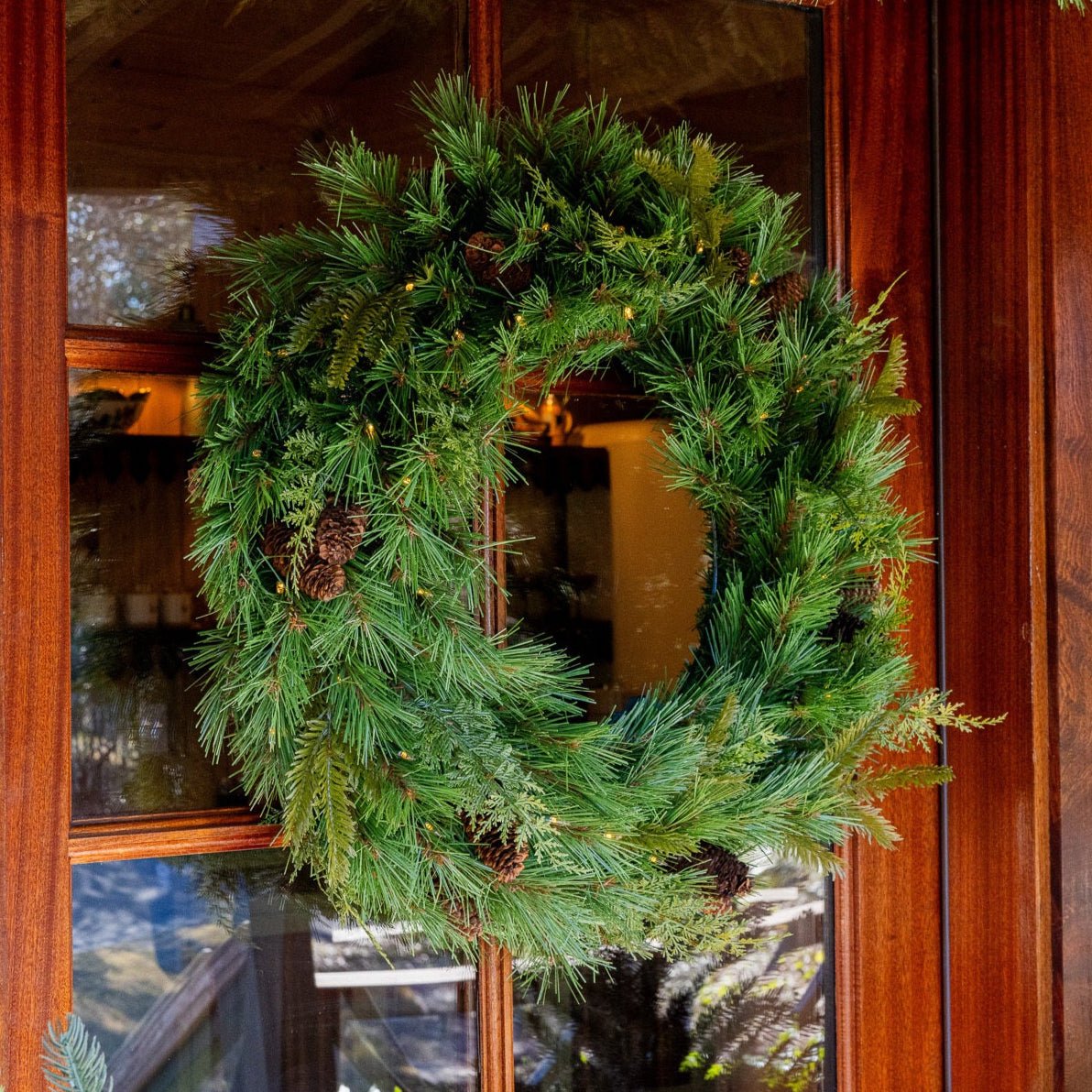
One wreath on the front door is easy. The moment you add a second on a window, a third over the mantel, and a fourth on the back door, coordination becomes the whole game. Done well, a set of wreaths ties a home together into one warm, intentional look. Done carelessly, they read as a mismatched collection that never quite agrees with itself. The good news is that cohesion comes from just a handful of choices, the collection, the light, the size, and the accents, kept consistent. Here is how to coordinate multiple wreaths across your home into one look.

Coordinating wreaths is not about making them identical; it is about making them clearly belong together. Let me walk through the few things to keep consistent and the one or two you can let vary.
Keep four things consistent: the collection, the light, the size logic, and the accents. Choose one wreath collection so the foliage matches everywhere, set every wreath to the same light color and sync their timers so they glow together, vary the size by location rather than the style, and repeat the same accents like berries or ribbon on each. When those hold steady, a scattering of wreaths becomes one deliberate look, even across several doors and windows. The checklist below captures it at a glance.
Cohesion is really about repetition. The eye reads a group of objects as belonging together when they share obvious traits, so the job is to give your wreaths a few strong common threads and let everything else follow. The single most powerful thread is the collection: because our wreath collections each have their own foliage character, choosing one, say all Plymouth or all Aspen, means every wreath in the house shares the same greenery, and half the coordination is done. From there, matching the light color and timing, sizing by spot rather than style, and echoing the same accents lock it in. None of it is fussy; it is just deciding on your common threads once and applying them everywhere.
| Collection | Use one collection so the foliage matches everywhere |
| Light color | Set every wreath the same, all warm white or all multicolor |
| Timing | Activate them together so they glow and rest as one |
| Size | Vary by location, largest on the door, same style throughout |
| Accents | Repeat the berries, pinecones, or ribbon, or keep all plain |
Matching one collection is the easiest, most reliable path to a cohesive look, and it is what I recommend for most homes. You can mix collections, but only if they share a palette and feel, for example two collections that both feature real pinecones and red berries, so they read as relatives rather than strangers. Avoid mixing very different styles, like a lush mixed-evergreen wreath beside a plain one, which looks accidental. When in doubt, stay within one collection and vary the size instead; that gives you variety without any risk of clashing.
Matching and mixing are both valid, but they carry different risk. Matching one collection is close to foolproof: every wreath shares the same tips, the same pinecones, the same overall character, so they cannot help but coordinate. Mixing collections can look wonderfully layered and collected, but it asks more of your eye, because it only works when the collections truly share a palette and mood. If two of ours both carry real pinecones and warm red berries, they can sit together happily; if one is a full, mixed-evergreen style and another is markedly different, the pairing reads as unplanned. So mixing is for when you have a clear plan and a shared thread to hang it on. For everyone else, and for most homes, one collection in varied sizes is the safest route to a look that feels designed. You can browse each in our wreath collection, and our wreath buyer's guide explains how the collections differ.

Vary the size by location while keeping the same collection. Put the largest wreath where it makes the biggest statement, usually the front door, often a 24 or 30 inch. Use smaller matching wreaths on windows, and a mid-size one over the mantel, typically a 24 inch for a standard shelf. The rule is simple: change the diameter to suit each spot, but never change the style, so every wreath still reads as part of the same set. Scaling by location gives you pleasing variety without breaking the coordinated look.
Sizing is where you get to introduce variety without risking cohesion, because a set of wreaths in different sizes but the same style looks intentional, like a family of different heights. Give the front door the largest wreath, since it is the focal point of the facade; a 24 inch suits many doors and a 30 inch makes a grander statement on a taller one. Windows take smaller wreaths so they stay in proportion to the pane and to the door wreath above or beside them. Over a mantel, a 24 inch is the usual choice for a standard shelf. The one rule that holds it all together is to change only the diameter, never the collection or style, from spot to spot. Our wreath sizing guide helps you match each diameter to its space.
Set every wreath to the same light setting using its dial, all warm white or all multicolor, never a mix, since one multicolor wreath among warm white ones stands out for the wrong reason. Then sync the timers so they light and darken together: because each battery wreath's timer repeats from the moment you switch it on, activate them all within the same few minutes at your chosen evening time. From then on, the whole set comes on and goes off as one. Consistent color and consistent timing are what make several lit wreaths feel like a single display.
Light is the detail that quietly makes or breaks a coordinated set of lit wreaths. Our wreaths have a dial to choose warm white or multicolor, which is a lovely feature, but it means you have to make the same choice on every wreath, because a single wreath glowing multicolor in a row of warm white ones instantly looks like a mistake. Pick one setting for the whole house and set each wreath to it. Then handle the timing the same way you would for the rest of your display: since each wreath's timer counts from when you turn it on, switch them all on within the same few minutes at your chosen evening hour, and they will glow and go dark together every night after. Our guide to putting your whole display on one timer schedule covers this syncing in detail.
Pull your garland from the same collection as your wreaths, and the whole facade becomes one continuous look, the door wreath, the garland framing the door, and the window wreaths all sharing the same foliage. Match the light color across the greenery too, all warm white or all multicolor, and echo the same accents, such as red berries or a ribbon color, from the wreaths into the garland. When wreaths and garland come from one collection and share a light and an accent, the entrance reads as a single designed moment rather than separate pieces that happen to be near each other.
Wreaths rarely decorate alone, so the final step in coordination is tying them to the garland and greenery around them. The most seamless way is to buy your wreaths and garland from the same collection, so the tips, pinecones, and berries all match; then a door wreath, a garland arching over or framing the door, and wreaths in the flanking windows all belong to one family. Carry the same light color across every piece, greenery included, and repeat a shared accent, if the wreaths have red berries and a velvet bow, let the garland carry the same, so the whole entry speaks with one voice. This is the difference between a facade that looks professionally styled and one that looks assembled from separate purchases, and it costs nothing extra beyond a little planning at the point of buying.

Pick one collection, one light, and one accent, then vary only the size, and every wreath in your home will read as part of one warm, intentional look.
Shop artificial wreaths The wreath buyer's guideYou might also be wondering: how many wreaths is too many? There is no hard number, but the guide is to place them where they serve a purpose, the front door, prominent windows, the mantel, a back or side door you use, rather than filling every possible spot. A few well-placed, coordinated wreaths look far more elegant than a wreath on every surface. When in doubt, do fewer, and make sure the ones you use clearly belong together.
Tap a question to see the answer.
A home dressed with several wreaths can feel either richly layered or slightly chaotic, and the difference is coordination. Choose one collection so the greenery matches, set every wreath to the same light and sync their timers, vary only the size from door to window to mantel, and repeat a shared accent throughout. Tie the garland to the same family, and your whole home speaks with one warm, intentional voice. A little planning at the point of buying is all it takes to turn a handful of wreaths into a display that looks designed.
Shop artificial wreaths The wreath sizing guideWreath collections, sizes, and colors are current at the time of writing and may vary. Our wreaths are cordless and lightweight for indoor or outdoor use, with a dial for warm white or multicolor light and a built-in timer. Follow the manufacturer's instructions for batteries, the timer, and hanging.


Ready for a holiday season with all glow and no upkeep? The full Christmas range is ready to shop.
SHOP CHRISTMAS DECOR
