

Cart
0
You may also like


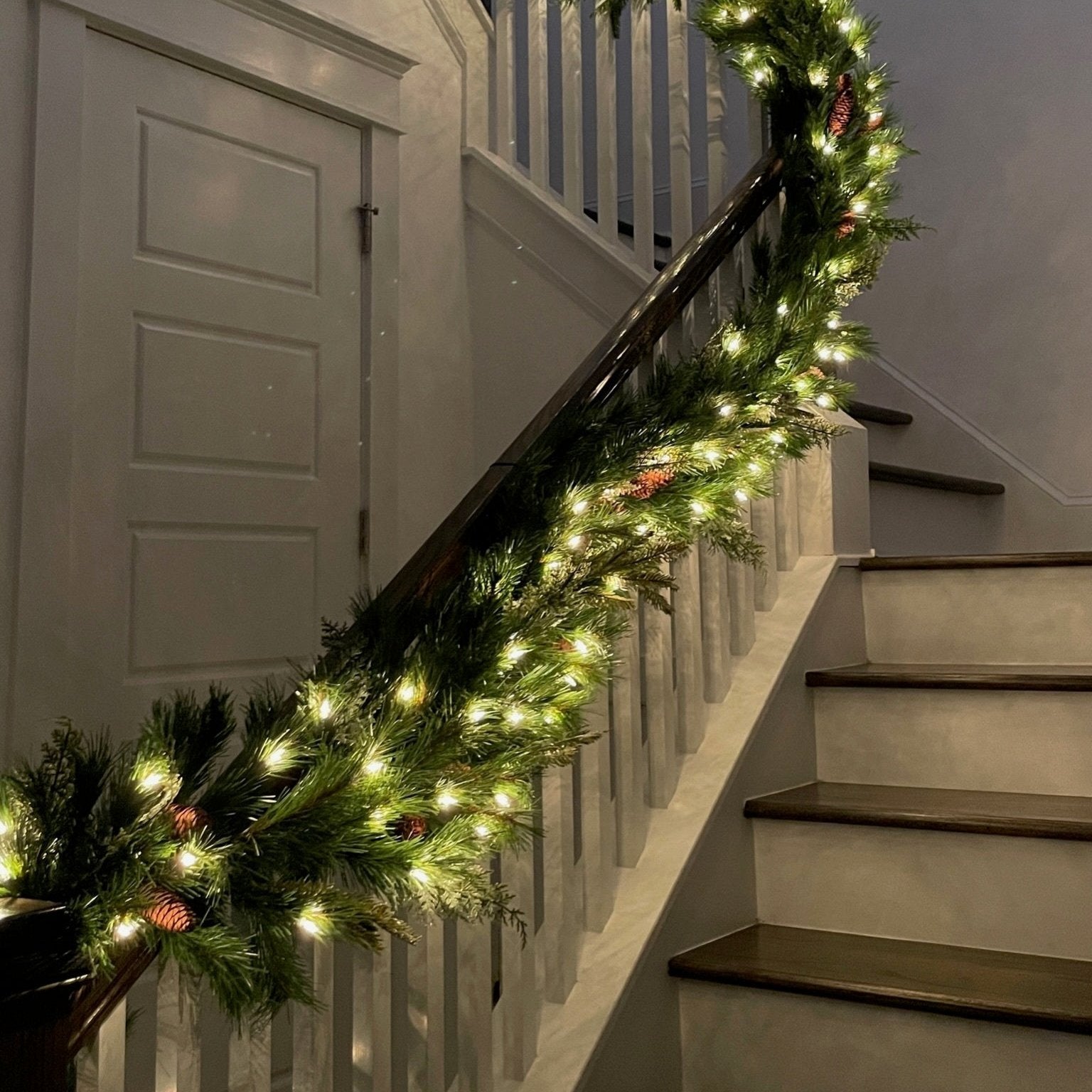
A long railing, a sweeping staircase, or a wide porch needs more than one length of garland, and the goal is to make several read as a single, continuous piece. That is exactly what our garlands are built to do. Each is 9 feet, and they connect end to end so a run of any length looks seamless rather than pieced together. This guide covers how to connect them, how many you can join on one outlet, how to hide the joint so it disappears, and how to shape and secure a long run so it looks professional.

The trick to a long garland run that looks custom rather than cobbled together is all in the connection and the joint. After years of dressing railings and mantels, I can tell you it is easier than it looks, as long as you know how your garlands join and how to blend the seam.
It depends on the power type. Plug-in garlands have a built-in plug at each end, so you connect one into the next, end to end, and a single outlet powers the chain. Battery garlands do not share power; instead, each has green wire-coated hooks on both ends that link one garland to the next mechanically, so they hang as one continuous piece while each runs on its own battery pack and timer. Either way, you join them end to end and then blend the tips at the joint, and the result reads as a single long garland.
The connection itself takes seconds. With plug-in garlands, the male plug on one garland meets the female socket on the next, the same way pre-lit strands join, so the whole run lights from one outlet. With battery garlands, the green wire-coated hooks at each end loop together to hold the garlands in line, and because each keeps its own sealed battery pack, there is no cord and no outlet involved at all. In both cases the physical join is the easy part; making the seam invisible is where a little technique comes in, which we get to below.
You can connect up to three plug-in garlands end to end on a single outlet, which gives a continuous run of about 27 feet. Three is the safe limit for one outlet, so for a longer plug-in run, start a fresh chain from a second outlet. Battery garlands have no such electrical limit, since each is powered by its own battery pack; you can link as many as you like with the end hooks for a run of any length, just set each garland's timer to the same schedule so they light and dim together.
The three-garland rule for plug-in is about not overloading a single outlet, and it is worth respecting. Three 9-foot garlands connected end to end reach about 27 feet, which covers most railings, mantels, and doorways from one plug. If your run is longer than that, simply begin a second connected chain at another outlet and let the two meet, blending the tips where they join so the transition is invisible. Battery is the more flexible option for very long or outlet-free runs: because every garland carries its own power, you can keep linking them along a fence, a gate, or a rooftop line as far as you want, with the only housekeeping being to sync their timers. For choosing between the two, see our guide to plug-in vs battery-operated garland.

Blend the two ends into each other so the joint disappears. Overlap the last few inches of one garland with the first few of the next, then intermix the end tips, tucking branches from each into the other and pulling the pinecones and berries forward to fill the gap. Fluff and shape both ends generously, brushing the tips out so no bare spine or plug shows. Done well, the eye reads a continuous line of greenery with no visible break, which is what makes a connected run look custom rather than pieced together.
The seam is the only place a connected run can betray itself, and hiding it is simple once you know the move. Bring the two ends together with a slight overlap rather than butting them end to end, so the greenery from each garland occupies the same few inches. Then work the tips: our garlands have a bendable wire center, so you can pull individual branches from each end and weave them into the other, layering the foliage over the joint. Draw the real pinecones and berry clusters toward the front of the seam to draw the eye, and fluff both ends fully so the branches fill in. Any plug or hook tucks up behind the greenery. The result is one unbroken sweep of garland where the connection used to be.
Both connect into seamless long runs; the right one depends on the spot. Plug-in is best where an outlet is handy and you want maximum brightness, joining up to three on one plug for about 27 feet. Battery is best for railings, gates, columns, or rooftops with no cord path, since each garland is self-powered and you can link any number with the end hooks. Plug-in gives you one switch for the whole chain; battery gives you unlimited length and no cords, with each garland on its own timer. Many homes use plug-in indoors and battery outside.
For a long run specifically, the deciding factor is usually power access. Where you have a convenient outlet, plug-in is wonderfully simple: connect up to three, plug in once, and the entire run lights and, on an outlet timer or smart plug, runs on a schedule. Where there is no outlet, which describes most long exterior railings, gates, and rooftop lines, battery wins easily, because every garland brings its own sealed pack and timer, so you can link a dozen if you like with nothing to plug in. The trade-off is that a plug-in run shares one switch while a battery run relies on each garland's own timer, easily solved by setting them all the same. Our ultimate garland guide covers the full picture of lights, power, and collections.
| Each garland | 9 feet long |
| Plug-in run | Up to 3 on one outlet, about 27 feet |
| Battery run | Linked with end hooks, each self-powered, any length |
| The joint | Blend and fluff the end tips to hide the seam |
| Shaping | Bendable wire spine, brush the tips out one direction |
Once connected, shape the whole run and fix it in place. Use the bendable wire center to drape and curve the garland along a railing or mantel, then fluff it by pulling the branches out perpendicular to the spine and brushing them in one direction for fullness. Secure a long run at intervals with green floral wire, zip ties, or the built-in hooks, so the weight is supported and it does not sag between points. Work along the whole length after connecting, so the joints and the fullness are consistent from end to end.
A connected run is only as good as its shaping and support. Start by draping the joined garland where it will live, using the flexible wire spine to follow a railing's line or swag it between posts. Then fluff: pull each branch out from the center and brush the tips in a single direction, three or four passes, until the garland looks full and the spine disappears, paying special attention to the joints so they match the rest. For a long or outdoor run, anchor it every few feet with green floral wire or zip ties around a railing, or loop the end hooks over balusters, so gravity does not pull it into a droop over the season. Done end to end, a multi-garland run looks like one polished, professional length of greenery.

Dress any length of railing, staircase, or porch: connect our 9-foot garlands into one seamless run, up to three on a plug or as many as you like on battery, then fluff and go.
Shop artificial garlands The garland guideYou might also be wondering: do the garlands have to match to connect? They connect regardless, but for the most seamless look, join garlands from the same collection so the greenery, tips, and berries are consistent across the seam. Mixing collections can work as a deliberate blend, but matching is the safest route to a run that reads as one continuous piece.
Tap a question to see the answer.
Connecting garlands is how you dress a long railing, a grand staircase, or a wide porch so it looks intentional and full rather than pieced together. Join our 9-foot garlands end to end, up to three on a single plug or as many as you like on battery, blend the tips at each seam, and shape the whole run with the bendable wire spine. The connection is quick, the seam disappears with a little fluffing, and the finished sweep of lit greenery looks like one custom, professional length.
Shop artificial garlands Plug-in vs battery garlandDo not exceed three connected plug-in garlands on a single outlet. For outdoor plug-in use, use outdoor-rated, GFCI-protected outlets and follow the manufacturer's connection and weatherproofing instructions.


Ready for a holiday season with all glow and no upkeep? The full Christmas range is ready to shop.
SHOP CHRISTMAS DECOR
